
Generations Explained: Names, Birth Years & Ages
Which generation are you? Here is every generation from the Greatest Generation to Generation Beta, with the years each was born, how old each group is in 2026, and what shaped them. Use the free tools below to find your generation, compare two generations, or map your whole family.
Free Generation Tools
These tools calculate instantly in your browser, always use today's date, and keep working once the page has loaded.
What Generation Am I?
Enter a birth year or an age to see your generation, its birth years, and whether you are on a cusp.
How Old Is Each Generation?
Pick any year, past or future, to see the age range of every generation that year.
Compare Two Generations
See the typical age gap, today's ages, and how their experiences differ.
Family Generation Mapper
Type one person per line with a birth year, like "Grandma 1948". Nothing is sent or saved.
Generation Timeline
Every generation by birth years. The red line marks the current year.
Generation Chart: Names, Birth Years, and Ages in 2026
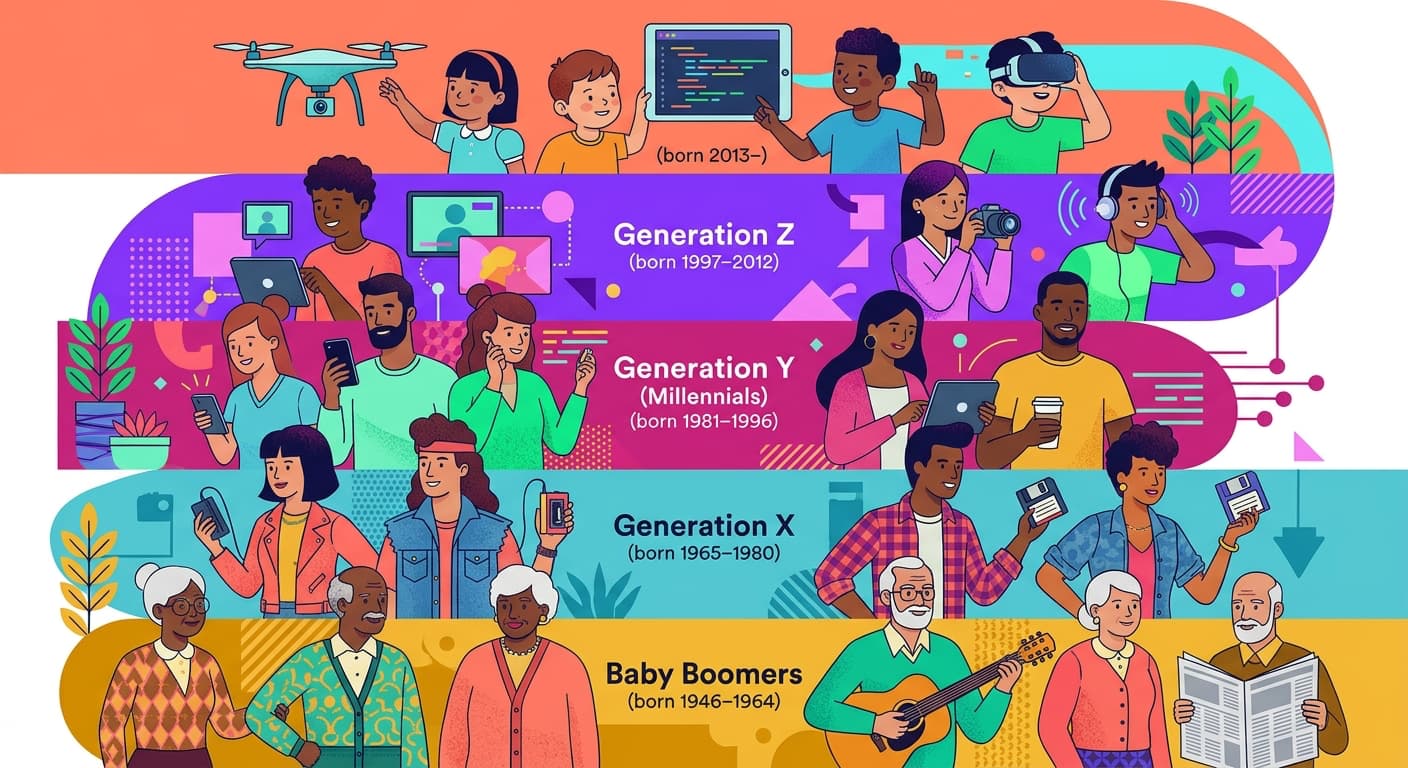
Birth years follow Pew Research Center for the Greatest Generation through Generation Z, and McCrindle Research for Generation Alpha and Generation Beta. Tap a card to jump to its details.
Meet Each Generation
Greatest Generation
Journalist Tom Brokaw popularized the name in his 1998 book The Greatest Generation. They grew up during the Great Depression, and many served in or supported World War II.
Defining events: World War I aftermath, the Roaring Twenties, the Great Depression, World War II.
Known for: Thrift, duty, and sacrifice. Many used the G.I. Bill to attend college and buy homes. Only a small number are still living, and most are over 100.
Technology: Radio, the telephone, and early television.
Silent Generation
Time magazine used the label in 1951 for young Americans seen as cautious and hardworking rather than outspoken. It is a smaller generation because birth rates were low during the Depression and the war.
Defining events: The Depression, World War II, the Korean War, the early Cold War, the rise of television.
Known for: Loyalty to employers, saving money, and respect for institutions. Many built long careers at one company, and many civil rights leaders came from this group.
Technology: Radio and early TV, later computers and smartphones in retirement.
Baby Boomers
Named for the surge in births after World War II, with about 76 million babies born in the U.S. Boomers reshaped schools, housing, and the economy at every stage of life, and were the largest generation until Millennials passed them.
Defining events: The Cold War, civil rights, the Vietnam War, the moon landing, Woodstock, Watergate.
Known for: A strong work ethic, optimism, and career focus. Many are retiring now, with millions turning 65 each year through the late 2020s. Some researchers split them into Leading-Edge (1946–1955) and Generation Jones.
Technology: Television as the main medium, then PCs, email, and smartphones as adults.
Generation X
Popularized by Douglas Coupland's 1991 novel Generation X. A smaller generation sandwiched between two very large ones, often called the "forgotten" generation.
Defining events: Rising divorce rates, the end of the Cold War, the fall of the Berlin Wall, the AIDS crisis, MTV, the Challenger disaster.
Known for: Independence, adaptability, and skepticism. Many were latchkey kids. Now in peak leadership roles and often caring for both children and aging parents.
Technology: The last generation to remember life before the internet, and the first to grow up with home computers and video games.
Millennials
Authors William Strauss and Neil Howe coined the name for those who would come of age around 2000. In 2019, Pew Research Center reported Millennials had passed Boomers as the largest U.S. adult generation.
Defining events: The September 11 attacks, the Great Recession, the rise of social media, student debt.
Known for: Flexibility, purpose at work, and experiences. They delayed marriage, homebuying, and parenthood compared with earlier generations, and are now the largest share of the workforce.
Technology: Remember dial-up and flip phones, then helped drive smartphones, streaming, and social platforms.
Generation Z
The first generation to grow up with the internet and smartphones from early life, and the most racially and ethnically diverse generation in U.S. history.
Defining events: The Great Recession, smartphones and social media, school safety concerns, the COVID-19 pandemic, climate change.
Known for: Comfort with technology, entrepreneurial interest, and openness about mental health. Older members are entering the workforce and favor flexibility and clear career growth.
Technology: Short-form video, group chats, and creator platforms.
Generation Alpha
Researcher Mark McCrindle chose the name from the Greek alphabet after Gen Z used up the Latin one. The first generation born entirely in the 21st century, expected to reach about two billion people worldwide.
Defining events: Tablets everywhere, the COVID-19 pandemic during early schooling, AI tools in everyday life.
Known for: Growing up with touchscreens and voice assistants. Most are children of Millennials, and the oldest are now young teens.
Technology: Likely to treat AI and smart devices as ordinary, as earlier generations did with television.
Generation Beta
Begins with births in 2025, using the same 15-year spans as McCrindle's other generations. Many will live to see the 22nd century.
Defining events: Everyday AI, automation, and personalized technology.
Known for: Parents are mostly Millennials and older Gen Z. Because these children are so young, descriptions are projections rather than established traits.
Technology: AI and personalized devices from birth.
Cusp Generations, Microgenerations & Earlier Generations
If you were born near the edge of a generation, you may not fit neatly into either one. Writers have given these in-between groups their own names. Earlier generations come from the Strauss–Howe model and other historians.
Generation Jones
About 1954–1965. Late Boomers who came of age during Watergate and the economic downturns of the 1970s rather than the 1960s.
Xennials
About 1977–1983. Born between Gen X and Millennials, with an analog childhood and a digital young adulthood.
Zillennials
About 1993–2000. Born between Millennials and Gen Z. They remember some analog technology but used social media as teens.
Missionary Generation
1860–1882. Reform-minded Americans active in the Progressive Era.
Lost Generation
1883–1900, also called the Generation of 1914. Writers such as Ernest Hemingway and F. Scott Fitzgerald belong to this group, which came of age during World War I.
How Generations Are Defined
There is no official definition of a generation. The U.S. Census Bureau does not set the boundaries, so research organizations choose them. Pew Research Center defines Millennials as born from 1981 to 1996 and Gen Z from 1997 to 2012, which is why most U.S. surveys use those years. Other sources shift the cutoffs by a few years.
Generations are usually grouped by shared formative events, such as wars, economic shocks, and new technology. Researchers also stress that labels describe broad averages. Differences between people in the same generation are often larger than differences between generations, and life stage explains many traits credited to generation.
Interesting Facts About the Generations
Largest adult generation
Millennials passed Baby Boomers as the largest U.S. adult generation in 2019, according to Pew Research Center.
Most diverse
Gen Z is the most racially and ethnically diverse generation in American history.
Biggest ever
Gen Alpha is expected to reach about two billion people worldwide, the largest generation ever.
Names from books
"Generation X" was popularized by a 1991 novel, and "Greatest Generation" by a 1998 book.
Not a science
Most generations span 15 to 19 years, but the length is a convention rather than a scientific rule.
Five at work
Up to five generations can be in the workforce at once, from late Boomers to early Gen Z.
Frequently Asked Questions
What generation am I?
Find your birth year: 1928–1945 is the Silent Generation, 1946–1964 is Baby Boomers, 1965–1980 is Generation X, 1981–1996 is Millennials (Gen Y), 1997–2012 is Generation Z, 2013–2024 is Generation Alpha, and 2025 onward is Generation Beta.
What years are Millennials?
Millennials, also called Gen Y, were born from 1981 to 1996 according to Pew Research Center. In 2026 they are ages 30 to 45.
What years are Gen Z?
Generation Z was born from 1997 to 2012. In 2026 they are ages 14 to 29.
What years are Baby Boomers?
Baby Boomers were born from 1946 to 1964, the years of the post-World War II surge in births. In 2026 they are ages 62 to 80.
What years are Gen X?
Generation X was born from 1965 to 1980. In 2026 they are ages 46 to 61.
What is the newest generation?
Generation Beta, born from 2025 onward, is the newest generation under the commonly used McCrindle definition. Generation Alpha (born 2013 to 2024) comes just before it.
Who decides when a generation starts and ends?
No official body does. Research groups such as Pew Research Center and McCrindle set the cutoffs, and the U.S. Census Bureau does not define generations. That is why birth-year ranges can differ by a year or two between sources.
What is a cusp generation or microgeneration?
People born near the boundary between two generations are called cuspers. Popular labels include Generation Jones (about 1954–1965), Xennials (about 1977–1983), and Zillennials (about 1993–2000).
Sources and notes: birth-year definitions follow Pew Research Center (Greatest Generation through Generation Z) and McCrindle Research (Generation Alpha and Generation Beta). Names and context draw on Tom Brokaw's The Greatest Generation, Douglas Coupland's Generation X, and the generational theory of William Strauss and Neil Howe. Ages are calculated for 2026, and boundaries vary by source.